The Significance and Process of Building the Roman Telescope
By Kaustav Singh
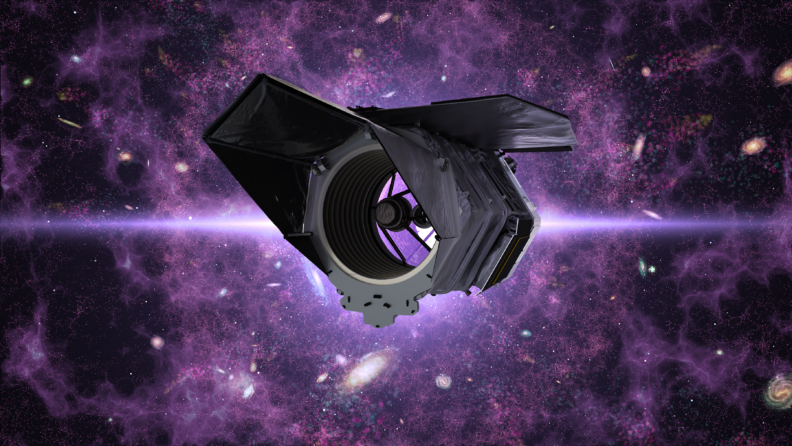
The Roman Space Telescope could change what scientists know about the universe, but for Dr. Tahani Amer, its impact extends beyond space. At Washington State University, she hopes the mission can spark the same curiosity and excitement in students that drive engineers to build technologies that have never existed before.
Dr. Amer, a professor in the ETM Program, and part of the management team for the Roman Telescope development team at NASA, shared her insight on what the Roman Telescope is built for, and what it will help capture in astronomy.
“Roman will perform a kind of a wide field survey of billions of galaxies to map how the matter is distributed, and how this universe’s expansion has changed over cosmic time,” Dr. Amer said.
While the Roman may seem more powerful than the James Webb and Hubble telescopes, Dr. Amer explained they just serve different purposes and complement each other.
“The Roman sees 100 to 200 times the sky at once, which you get a whole bigger survey. It’s a wider survey. While the Hubble gives us the depths, the Roman gives us the width,” Dr. Amer said.
Dr. Amer explained that while the Roman sees much wider and captures more of the space at once, it is too wide to understand all that is present in the image.
This is where the James Webb and Hubble telescopes complement the Roman Telescope and will help aid the Roman Telescope by getting more focused images of the bigger elements captured by the Roman.
“I worked in the Webb telescope too. Webb is higher sensitivity; it’s able to focus in the deep narrow targeting. The Roman has a slower, lower sensitivity than a web, but has a vast, larger view,” Dr. Amer explained.
Dr. Amer also explained her role in the building of the Roman Telescope, and the challenges that came with being part of the NASA team that was tasked with it.
“It’s like a very long process. You develop the part, you develop the optic instrument, the wide field, the chronograph, you integrate this as a payload, you put this in a spacecraft, you put the spacecraft on a rocket,” Dr. Amer said.
Dr. Amer explained the long and drawn-out process that was the Roman Telescope. From building each part separately, to assembling the parts to come together, and then putting the telescope in a spacecraft and a rocket, Dr. Amer painted the image of the many steps and moving parts of building the Roman Telescope.
Part of the challenge also came from the fact that NASA was out to build something that doesn’t exist, so to build something from scratch was part of the challenge as well.
“Because you’re building something new, never built before, and that is kind of… was really challenging for the team that build that,” Dr. Amer explained.
Dr. Amer also explained how the engineers and scientists had different roles in the process. The engineers were tasked with not only building the telescope, but also collaborating with the scientists and making sure the hardware and the software of the telescope fulfill the vision the scientists had.
“The scientists said, ‘we need—I need to be able to measure this.’ The engineer developed the requirement and the instrument, and it’s a very collaborative effort between science and engineering,” Dr. Amer said.
Dr. Amer also discussed the scale of how the Roman Telescope could change the understanding of astronomy and space science.
“We’re gonna show thousands and thousands of exoplanets, hundreds of black holes, you know. We understand billions of galaxies. We’ll watch supernovae. We’ll have 1.4 or 1.3 terabytes of data daily,” Dr. Amer said.
The sheer scale of how much the Roman Telescope can capture will change how much the NASA scientists know about space science. 1.4 terabytes of images captured daily from space will allow scientists to discover and study much more of the space than ever before, which is why the Roman Telescope will drastically change understanding of space science, especially black holes and dark matter.
“The Roman Space Telescope is going to make us rewrite the textbooks of physics. They’re going to rewrite our understanding of dark matter, dark energy, exoplanets, how many exoplanets are there, how the stars formed, what billions of galaxies are there,” Dr. Amer said.
Dr. Amer estimated the volume of data the Roman Telescope will help capture will be so monumental that the Physics textbooks students learn from today will no longer be up to date by the time the Roman Telescope’s missions are well under way.
Dr. Amer also expressed how she wishes the Roman Telescope and the findings that NASA publishes after its missions will inspire students the same way she was once inspired as a young student.
“From that aspect, the student takes this enthusiasm, and that energy, and that understanding to their field,” Dr. Amer said.
Dr. Amer wishes that the Roman Telescope and its findings inspire more curiosity amongst students and even if they don’t go into aerospace or astronomy, she wishes that they show the same curiosity and drive in their fields and keep learning.
“It’s not just finishing their master’s or PhD, it’s kind of… we are students of life, right? We don’t just stop by finishing our bachelor’s, we don’t stop until getting your Post-Doc, you don’t stop until you launch a mission. You will learn something new every day,” Dr. Amer said.
Dr. Amer hopes that students take her participation in the NASA Roman Telescope team as a reminder to always be inspired and be curious.
She also hopes it is a reminder that learning doesn’t stop at a bachelor’s, or master’s or PHD’s, her idea is that it never stops because there is always something new to learn especially in STEAM (Science, Technology, Engineering, Arts and Math) fields.
Dr. Amer explained that her philosophy in teaching is not to make sure students learn material, rather it is to make sure they learn to be inspired and learn from her experiences and other’s experiences and take those lessons to their respective fields.
“My goal is not only to give them the principle of engineering and system engineering or project management, it’s kind of let them learn from their mistake, let them learn, learn more, want to acquire more in that field,” Dr. Amer said.
Dr. Amer also shared her experience with the ETM students, and how they inspire her to be curious, with hopes that they get the same inspiration from her.
“My goal is to make the class a collaborative environment. I learn from them, they learn from me,” Dr. Amer said.
The Roman Telescope mission launched on Aug. 30, and has captured preliminary images as of October.
Dr. Amer relayed that NASA is now working on the Habitable World Observatory Telescope next, another project she is working on as well.
Watch the full interview with Dr. Amer on YouTube.
Dr. Amer is the Astrophysics Associate Director for Flight Programs- Acting Science Mission Directorate at NASA and WSU Engineering and Technology Management Adjunct Faculty. Dr. Amer will be teaching EM_564 Project Management in Spring Semester.